
Piscataway Roofing handles skylight installation in Piscataway, NJ, serving surrounding cities including Middlesex, Highland Park, Bound Brook, Metuchen and Manville. We install new skylights, replace old ones, reflash units that leak at the roof and remove skylights that owners no longer want. With more than 20 years of roofing behind us, we treat a skylight as a roofing detail first, because most skylight problems are flashing problems.
A skylight is a hole in the roof with glass in it, and keeping water out around it depends on how well it is tied into the shingles and underlayment. A good unit installed with the wrong flashing will leak, while a properly flashed unit can stay dry for decades. That is why every skylight we install comes with a flashing kit matched to the unit and the roof.
Many skylight calls start as leak calls. Before recommending a new unit, we determine whether the water is coming through the flashing, through a failed seal in the unit itself or from condensation inside the shaft, since each of those has a different fix.
Curb-Mounted and Deck-Mounted Skylights
Curb-Mounted Units
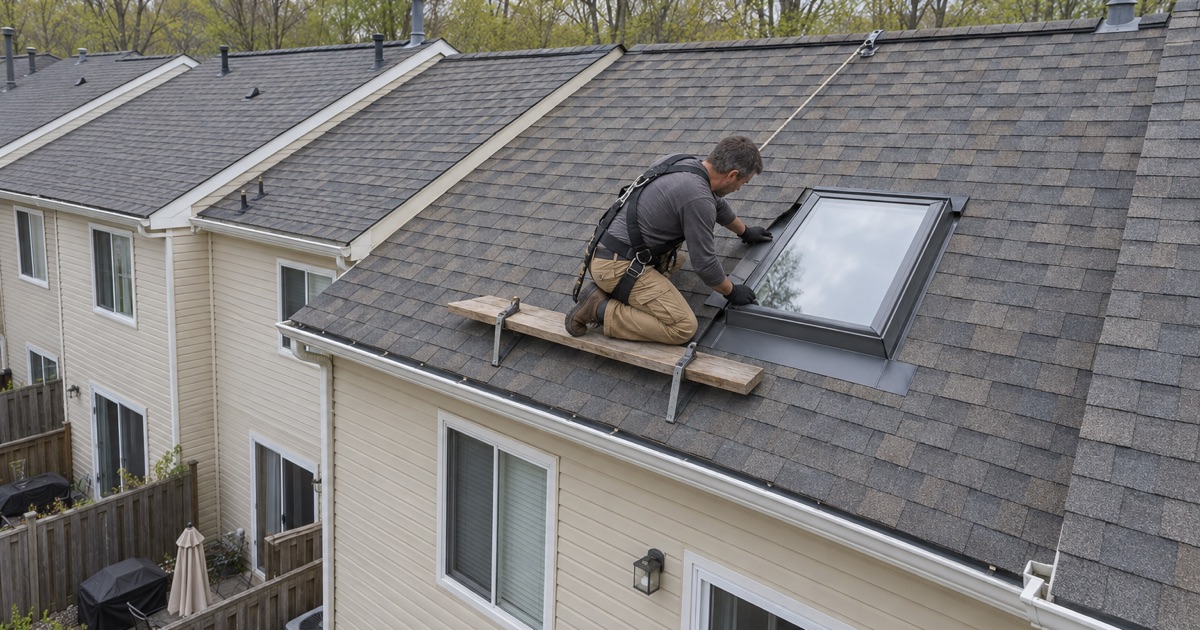
A curb-mounted skylight sits on a raised wooden frame, the curb, built up from the roof deck. The roof is flashed up the sides of the curb, and the skylight sits on top like a lid. Curb-mounted units are common on older homes and on low-slope roofs where a raised frame helps keep water away from the glass.
When an old curb-mounted unit fails, it can sometimes be replaced with a new unit sized to the existing curb, which avoids reframing. Where the curb itself has rotted, it is rebuilt before the new skylight goes on.
Deck-Mounted Units
A deck-mounted skylight fastens directly to the roof deck and has a lower profile on the roof. It is flashed with a kit designed for that unit, with step flashing pieces woven into the shingles along the sides, a head flashing at the top and an apron at the bottom.
Deck-mounted skylights paired with their manufacturer’s flashing kit and a self-adhering underlayment collar around the opening are one of the most reliable skylight installations on a shingle roof. That is our usual choice for new openings on pitched roofs.
Skylights on Flat and Low-Slope Roofs
On a flat roof over an addition or a commercial space, a skylight has to sit well above any water that collects on the roof. These units go on raised curbs, and the membrane, whether EPDM, TPO or modified bitumen, is turned up the curb and flashed so that standing water never reaches the joint under the skylight.
The curb height and the flashing method follow the membrane rather than the skylight brand. Getting that detail wrong is the most common reason flat roof skylights leak, and it is where we spend the most care on those jobs.
Replace, Reflash or Remove
Reflashing a Skylight
If the skylight itself is sound, with clear glass and intact seals, but water is getting in around it, reflashing may be all that is needed. The shingles around the unit are removed, the old flashing comes off, new underlayment and flashing go on and the shingles are relaid.
Reflashing is a good choice when the unit is relatively new. On an older skylight, the cost of reflashing comes close to the cost of replacing the unit, and replacement solves both problems at once.
Replacing an Old Skylight
Skylights that are fogged between the panes, have cracked glass or frames, or have leaked repeatedly are usually best replaced. New units are better insulated, which reduces both heat loss in winter and the condensation that drips from older single-pane or failed double-pane glass.
The best time to replace a skylight is during a roof replacement, when the shingles around it are already off and new flashing can be woven in with the new roof. Leaving an old skylight in a new roof often means opening the new roof again a few years later.
Removing a Skylight
Some owners find an old skylight brings in more heat and glare than they want, or simply leaks too often to be worth keeping. Removing one means framing the opening, sheathing it to match the roof deck, adding underlayment and shingling over it to blend with the surrounding roof.
Inside, the light shaft is closed off and insulated. The result is a roof with one less penetration, which is one less place for water to get in.
Skylight Placement and Condensation
Choosing Where a New Skylight Goes
A new skylight has to fit between rafters, or the rafters have to be headed off to make room, and it should not land where a valley, chimney or roof vent will throw water at it. We look at the attic framing and the roof surface together before marking an opening.
The direction the roof faces matters too. A south-facing skylight brings in more light and heat, while a north-facing one gives softer light with less heat gain, and we talk through what you want from the room.
Keeping Condensation Down
Water dripping from a skylight in cold weather is often condensation rather than a leak. Warm, humid air rises into the light shaft and condenses on the cold glass and shaft walls, particularly in bathrooms and kitchens.
Insulating the shaft, choosing an insulated unit and, in bathrooms, using a venting skylight or a properly ducted exhaust fan all reduce it. We point out condensation signs during the inspection so you are not paying to reflash a skylight that was never leaking from outside.
- 20+ Years Roofing
- Itemized Written Estimates
- Attic-to-Ridge Leak Tracing