
Piscataway Roofing provides flat roof repair in Piscataway, NJ, serving surrounding cities including Middlesex, Highland Park, Bound Brook, Metuchen and Manville. We repair EPDM rubber, TPO and PVC single-ply membranes and torch-down modified bitumen on porches, additions, garages, dormers, apartment buildings and commercial roofs. After more than 20 years on low-slope roofs, we have found that most flat roof leaks come from a handful of details, and fixing those details is what makes a repair last.
Flat roofs leak differently from shingle roofs. Water does not run off quickly, so any opening in the membrane is under water for longer, and the water that gets in spreads under the surface before it shows up inside. A stain on the ceiling under a flat roof is often several feet from the actual opening.
That is why a flat roof repair starts with the whole area around the leak, not just the spot overhead. We look at every seam, every wall flashing and every low spot that holds water, so the repair addresses the real cause rather than one symptom of it.
Flat Roofs on Piscataway Homes
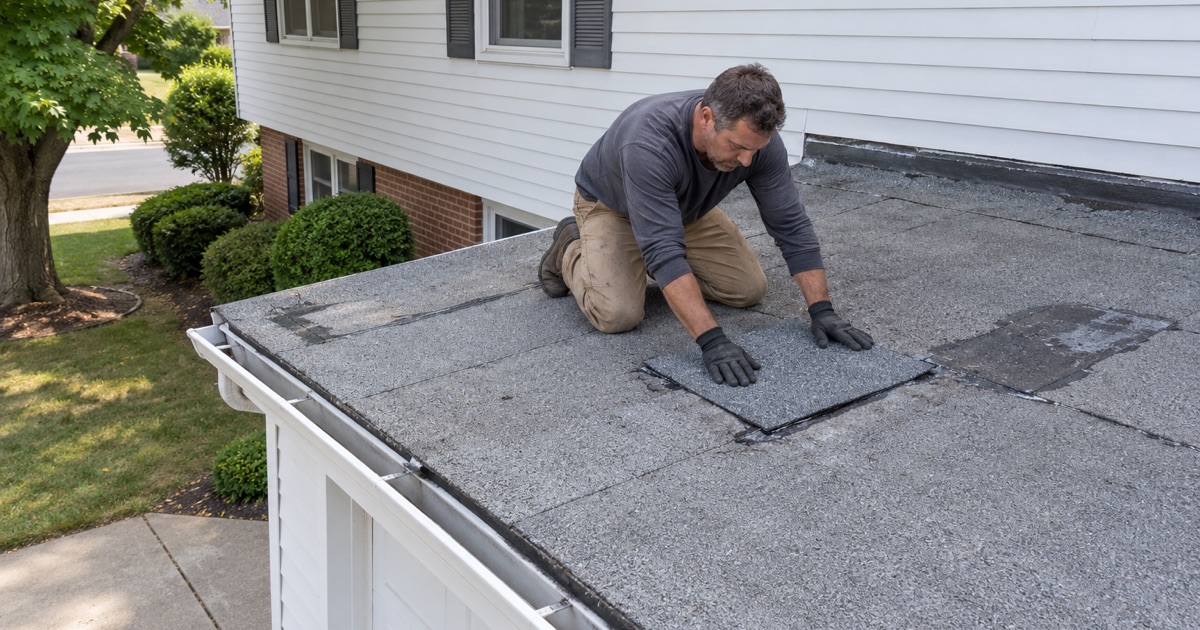
Porch, Carport and Addition Roofs
Many of the township’s ranches, split-levels and colonials were built between 1950 and 1979, and a lot of them have a low-slope roof over a front porch, a carport, a family room addition or a rear kitchen bump-out. Some of those sections were finished with shingles or roll roofing that was never suited to the pitch, and they leak at the seams and edges.
We repair what is there when it can be saved, and explain the option of converting the section to a membrane or standing seam metal when it cannot. On a small porch roof, a properly installed membrane often ends years of recurring leaks.
Where a Flat Roof Meets the House Wall
The joint between a flat roof and the wall of the house above it is the most common leak point on these sections. The membrane should turn up the wall and be covered by counter flashing tucked behind the siding or set into the masonry, so water running down the wall lands on top of the roof rather than behind it.
On many older additions, the membrane simply stops at the wall with a bead of sealant. We rebuild that detail properly, which often means removing and resetting a course or two of siding.
Repairs by Membrane Type
EPDM Rubber
EPDM is a black synthetic rubber membrane installed in large sheets. Its most common failures are seams that have lost their adhesion, punctures from foot traffic or falling branches, and shrinkage that pulls the membrane away from walls and edges.
Repairs involve cleaning and priming the rubber, then applying seam tape or cured patches that bond to it. Where shrinkage has pulled the membrane tight at a wall, we add a strip of new membrane so the corner is no longer stretched.
TPO and PVC
TPO and PVC are light-colored single-ply membranes with hot-air welded seams. They are repaired by cleaning the old membrane and welding new material over the damaged area, which forms a bond as strong as the original seams.
Older TPO can become difficult to weld as it weathers, and we test-weld before committing to a repair method. Where the old sheet will no longer take a weld, the honest answer may be replacement of that section.
Torch-Down Modified Bitumen
Modified bitumen in SBS or APP is built up in layers and heat-welded to the roof. It tends to blister where moisture is trapped underneath, crack at its seams with age and split along flashings at walls and curbs.
Repairs cut out the damaged area down to sound material and weld new layers over it with generous overlaps. Blisters are opened, dried and patched rather than simply pressed flat, because a sealed-over blister returns.
Ponding, Drains and Edges
Standing Water
Water that remains on a flat roof for more than a day or two after rain wears out the membrane faster in those spots and finds any weak seam. Ponding usually comes from a sagging deck, compressed insulation, clogged drains or a gutter edge set higher than the roof surface.
Small low spots can sometimes be built up with tapered material during a repair. Larger drainage problems are best corrected when the roof section is replaced, and we tell you which approach fits your roof.
Drains, Scuppers and Gutter Edges
On apartment and commercial buildings, water leaves through internal drains or scuppers through the parapet wall. On houses, it usually runs off an edge into a gutter. Each of those exits needs to be flashed into the membrane and kept clear.
We clear debris, reflash drains and scuppers and make sure gutters at the roof edge are sized and pitched to take the water away. A flat roof with a working exit is far less likely to leak than one where water waits for somewhere to go.
Coatings and When They Make Sense
Roof coatings can extend the life of a flat roof that is still dry underneath and sound overall, by sealing small cracks and reflecting heat. They are not a fix for wet insulation, a sagging deck or a membrane that is failing across the whole roof.
Before recommending a coating, we check the roof for soft spots and trapped moisture. If the roof underneath is waterlogged, coating it only hides the problem and wastes the money spent on the coating.
- 20+ Years Roofing
- Itemized Written Estimates
- Attic-to-Ridge Leak Tracing